Retro Reviews
Dragon's Maze: A Retro Design Review
The worst third set of one of the best blocks. The worst-ROI set in Magic’s history. Emmara Tandris getting rules-swapped with Voice of Resurgence so that the latter Constructed staple wouldn’t be legendary. You’ve heard the rumors about Dragon’s Maze, 2013’s closer of the Return to Ravnica block. I’m here to dispel them.
I’ll admit that DGM suffers from a fairly modest power level and a couple of quirks that come from its RTR-GTC-DGM block-draft structure. However, Cube design is more like scavenging and recycling than it is like Constructed’s cherry-picking. Our unsanctioned, customized draft formats allow us to sidestep the bulk of these complaints — and when we do, Dragon’s Maze reveals the endless treasures at its center.
Follow along on Scryfall:
set="Dragons Maze"Macro Incentives
Ten-Guild Draft
There are no absolutes in Cube design. In 2016 it was common Cube wisdom that most new curators played too many gold cards, and it was not possible to make a satisfying multicolor cube. Neither axiom turned out true. You can add more fixing lands; you can go the DMU route of optional splashes and Domain; you can choose your 5 favorite Shards or Wedges for an asymmetric guild distribution; you can give every player a Pillar of the Paruns to start the game. That said, Dragon’s Maze chose one of the hardest ways to incentivize multicolor draft: tons of true gold cards, from all ten guilds, with slow fixing options.
Narrow Ways to Splash
e:dgm o:fuseNearly half of DGM’s cards require two colors of mana to cast.1 Some of Magic’s past multicolor cards let players cheat the mana system a little — an off-color Kicker, hybrid, or other forms of opt-in color requirements — but not in DGM! You have to cram enough mana sources into your deck to merely cast your cards. Because DGM contains ten guilds, rather than the five of RTR or GTC (or even earlier multicolor blocks like ALA and INV), some guilds will go undrafted and their cards divvied up as splash colors or sideboard benchwarmers, multiplying the strain on a drafted manabase.
Unfortunately, DGM offers slim rewards for the manabase risk of splashing: off-color Gates can turn on the cycle of Gatekeepers, colorless fixing (the lackluster Cluestones) can ramp and splash, and Fuse provides off-color Kicker by a different name. These rewards are still pretty all-or-nothing, and leave a tantalizing possibility behind: what would Dragon’s Maze look like if it smoothed the mana of the RTR-GTC draft mashup? Some opt-in rewards and variance mitigation would go a long way here, and DGM misses the mark. Luckily, on a micro level, DGM quickly regains my trust.
Micro Interactions
Maze’s End
At first, DGM startled me with apparent dearth of internal synergies in this set. I wondered if I was looking at a latter-day Antiquities or Legends, more about cool individual designs than any cohesion. Or maybe a precursor to March of the Machine: The Aftermath, more about tying up loose ends in the story. Then I looked a little deeper, starting with a favorite Legend of mine as a teenager, Exava, Rakdos Blood Witch:
set:dgm o:'+1/+1 counter'See, Exava may herself have Unleash, but her haste-granting ability applies equally well to Scavenge in the adjacent Golgari deck. Mono-green counters payoffs are even more flexible, which bridge to Simic’s Evolve and also pay off Rakdos’ Unleash as a splash color.
Even some of DGM’s humblest cards bridge several archetypes. Deputy of Acquittals rebuys creatures with RTR’s Detain, but it’s equally synergistic with Evolve or Extort in adjacent guilds, and can even rescue a reckless Battalion attacker after its trigger. (If only the set’s mana-fixing made these combos more attainable!)
I especially love how just a sprinkling of combat keywords recontextualizes the blocks’ new mechanics. Rakdos Drake kinda spoils the joke by putting evasion and Unleash on the same card, but imagine how cool the Drake makes Firefist Striker or Thrashing Mossdog as one’s draft lane shifts among different two-color pairings.
Dragon’s Maze, then, stands in stark contrast to the 2020s pattern of cheesy, self-solving synergies. There’s no “when you bingus your bongus, bongus your bingus” here.2 Dragon’s Maze has zero tolerance for rote, pre-solved synergies. It offers tools with some immediate applications, but the deeper connections are left implicit, for the players to discover.
And most implicit of all is DGM’s eponymous Maze. The classic dreamchaser, Maze's End. You Win The Game. This is one of the most perfect Magic cards out there, and not because it’s “strong,” but because it’s fun. Fun for everybody! For the Johnny trying to build all-in Gate synergies, for the Spike trying to optimize the distribution of lands, for the brand-new cube drafter who didn’t realize such a card was possible. Cards like this are why I just can’t quit Dragon’s Maze.
Other Cards I like
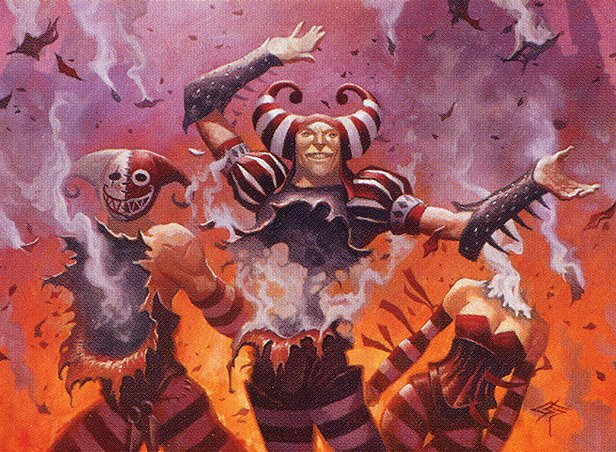
Nivix Cyclops has sweet art and plays well. Kiln Fiend is a bursty design, capable of one-turn kills if you save up a critical mass of spells, and our Cyclops’



Varolz, the Scar-Striped is a very cool combo piece with Phyrexian Dreadnought (or, for real humans with budgets, Hunted Horror, Death's Shadow, and Vexing Devil). I especially like that Varolz puts mega power/toughness on other creatures, which means that every combat keyword in your deck gains new context.
Scion of Vitu-Ghazi is good, clean Magic. Populate is so cool! And fan me off if you ever get to sequence Advent of the Wurm into Scion. (Advent, by the way, is my sleeper hit on power level from DGM. I think Standard Delver’s Vapor Snag ate Advent’s lunch in 2012, but in Cube a 5/5 Flash at this cost is still perfectly reasonable.)
Art and Flavor
Lavish Guild Art
I maintain that the second Ravnica block combines modern-day worldbuilding with some of Magic’s most lush, vivid paintings. In DGM, the artists go all-out. The black cards are the rich lavenders, oranges, and greens emblematic of the 2010s. White cards are griseille fogs of ambient light contrasted with dynamic action shots, and so on. This is Magic’s art direction at its best.
Many pieces even reference classic works. Sire of Insanity’s pose references Goya’s Saturn Devouring His Children. Art Young’s Eleven Hour Day, which rages against child labor in the US’ Gilded Age, is turned into a critique of the Orzhov’s religio-capitalism in Maw of the Obzedat.
And then there’s Ravnica’s gates themselves. All ten DGM gates zoom out from the versions earlier in the block, situating the guilds’ bitter conflict of the Implicit Maze within a megalopolis of citizens whose well-being depends on the outcome. The move creates a sense of monumental, baroque awe:
Bravo, Jeremy Jarvis and the art team of DGM. Take a bow.
I will admit that the power level of Dragon’s Maze is anachronistically modest — I wouldn’t shy away from combining DGM with the 2005 RAV block, but all its spells fall short of the greatest hits of 2019’s WAR block. (Well, save for Voice of Resurgence!) These cards won’t always be in dialog with Magic’s average card nowadays.
However, any cube can learn from DGM’s humbly emergent synergistic overlaps, and appreciate its superb art direction. Step beyond resale value and DGM is an unmitigated joy to discover, and that’s all we need for a great Cube design set.