Design
The Game Design Pitfalls of Crossovers
Universes Beyond (UB), the umbrella term for Magic’s crossover sets with other fictional properties, is experiencing growing pains. Discussion often centers around UB’s economic health or its value as a consumer product, but today I want to examine its success as a game. How well does the Magic rules system adapt other fictional worlds, per Magic’s own gameplay precedents?
Magic’s Double-Edged Sword
The color system is Magic’s greatest strength and hardest boundary. The five colors each have unique strengths and weaknesses, a concept called the “color pie.” If every color were equally good at every task, why would you ever add a second color to your deck, or adapt to your local metagame by trading for cards in a situationally strong color? The color pie puts the trade in the Trading Card Game. It’s so influential that head designer Mark Rosewater calls it one-third of Magic’s Golden Triumvirate of game-design innovations.
Just as important, Magic’s color pie is not simply a distribution of mechanics, but an ideology. Each color has a motive, a means, and an aesthetic to go along with its mechanics. White is virtuous and civic-minded, Blue is intellectual and curious, Black is selfish and cunning, Red is impulsive and freespirited, and Green is naturalistic and strong. Color philosophies elevate Magic’s gameplay from mere tactics to a game narrative, where game mechanics become self-explanatory with story-telling and flavor, and where players even begin to identify their human personality with their in-game color.
“In the color pie, flavor dictates function... It clarifies each color's philosophy and then [bends] mechanics around it.”
Magic’s color pie requires hard boundaries to keep its flavor consistent. For example, Goblins are the impulsive mascots of Red, and after 35 years, there are still zero mono-white and zero mono-blue Goblins.1 Jace Beleren has been around since 2007, but his ideology has never strayed far from ”arrogant flavor text on Counterspell variants.” But when Magic adapts other fictional worlds, that strength can become a confusing liability. As a case study, I’ll mostly restrict myself to the one Universes Beyond property I know well, Avatar: The Last Airbender.
An Avatar Crash Course
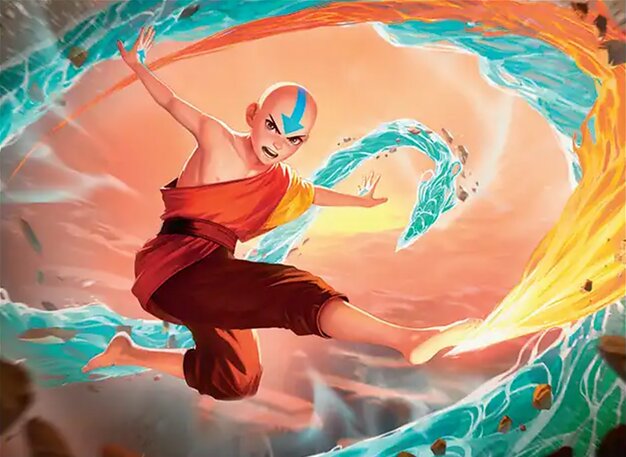
Avatar: The Last Airbender is a story of four nations: the Air Nomads, the Water Tribes, the Earth Kingdom, and the Fire Nation. Each nation can manipulate their eponymous element through a mystical martial art called “bending,” a gift given to mortals by the spirits who populate the world. The peacekeeper between the Four Nations is the Avatar, master of all four elements and bridge to the Spirit Realm. ATLA follows the latest incarnation of the Avatar, an Air Nomad child named Aang. He “gaangs” up with fierce waterbender Katara, her clever-and-yet-also-dumb brother Sokka, tough-as-nails earthbender Toph, and many allies and adorable critters. Their task: to save the world from the ravages of the Fire Nation, an empire led by fanatical Prince Zuko and his tyrannical father, Fire Lord Ozai.
A central emotional drama of ATLA is the clash between Aang’s pacifist ideals, his unwanted destiny as the Avatar, and the Gaang’s myriad adversaries. As a hundred-year war draws to its finale, Aang must choose: kill Fire Lord Ozai in violation of his deepest-held beliefs, or allow the world to suffer under Ozai’s boundless cruelty. ATLA is a visual treat and a compelling all-ages epic, one that a spoiler-free summary hardly does justice. Let’s see if Magic’s rules can do any better.
Color Pie Crossovers
Imagine we’ve been given the task of bringing Avatar: The Last Airbender into Magic. Let’s start with Air Nomads, who are described by Avatar lorekeepers as “the most spiritual of all [four] cultures,” airbenders who “lived in harmony with nature,” kept “sacred vows of nonagression,” and who pursue mastery of air. Which color of Magic best represents the mechanics and flavor of Avatar Aang, the Airbender?
The


But color is more than mechanic, and ideologically, neither Blue nor Green fits Aang perfectly. He values harmony between spiritual and mortal realm, which is again best expressed by Green, but his pacifistic and selfless respect for all life strikes me as White.2 And Aang’s a fun-loving troublemaker (he’s 12, after all), but that’s often Red or Black. So… does that make Aang four colors, then? Maybe it works for one Mythic Rare, but a four-color main character is hardly a recipe for a draftable Magic set. (Maybe it’s easier to just shortcut Aang to White since he wears a yellow/orange outfit.)
It’s harder than it looks! In-universe Magic characters never have to deal with this problem. Chandra Nalaar’s personality (not to mention her always-coordinated hair and outfits) exactly coincides with Red’s ideology of self-actualization, and her powers exactly coincide with Red’s magic. It’s not an overstatement to say that Chandra can’t undergo major character change or gain temporary mastery over another element unless she gets a bonus color of mana (just like they did with Ajani). In contrast, a character as complex as Avatar Aang will have to be flattened into just one aspect of personality.
But whether or not you agree with my design priorities, Aang’s color identity isn’t even the biggest single challenge of adapting ATLA to Magic! Aang’s central emotional conflict in ATLA is his refusal to take life. (Seriously, multiple episodes entirely revolve around Aang’s turmoil when faced with the duty of defeating the Fire Lord.) Meanwhile, in Magic’s rules engine, the only word that describes the outcome of most combat is “dies.” Does Aang need to have 0 power so his enemies won’t “die”? Or do we make a sweet 4/4 creature and pretend he’s just “knocking out” his enemies, comprehensive rules notwithstanding? The centrality of Aang’s pacifism to the story of ATLA is literally inexpressible using the rules of Magic.
Compromised Crossovers
You might say, at this point, that these are the quibbles of a major nerd, and the cards we have will be fine in Standard and Commander, which is all we can reasonably ask. Or, if I had only read page 243 of the third novelization, I’d change my tune about Aang’s motivations. Look, the last thing I want is to gatekeep enjoyment of Magic or ATLA. My claim is strictly one of game design. If your goal is to create flavorful Magic gameplay, or to capture ATLA through a TCG, then the Magic x Avatar set is not the best way to accomplish either goal. These shortcomings are obvious even from the small number of available previews at time of writing:
Katara is especially jarring to me. Late in Book One where this card occurs, Katara is Aang’s closest friend and a passionate freedom-fighter, always seeking to do right by her inner moral compass. She’ll gladly kill her enemies if it keeps Aang safe; she impulsively challenges the sexist waterbending master Paku to a duel; she steals a rare martial-arts scroll with zero escape plan. Which of Magic’s planeswalkers sounds closest to Katara’s personality and values: Jace, Chandra, Liliana, Garruk, or Ajani? My answer is Chandra, and I expect yours is, too.3 But Katara is a water-and-ice mage who almost always sports a blue outfit, and Magic is a game incapable of making an ideologically Red water mage.
These conflicts may not be a big deal for one set. In fact, ATLA looks like a lot of fun. But the conflicts reveal that Magic’s color pie isn’t a universal truth about human psychology; it is a creation of three decades’ precedent and nothing more. The more that crossovers require tweaks to the color pie, the less cohorent Magic’s colors will feel within its own Eternal formats, the same way that mechanical bends and breaks continue to haunt Legacy and Commander. If Blue is used to adapt passionate and self-determined freedom-fighters like Katara, does that mean Blue and Red’s 30-year conflict of philosophies was about nothing more than the color of their clothing?4
When deep and nuanced crossover characters are compressed to fit into Magic, they make the color pie’s too-neat artificiality obvious. Magic is not a universal rules engine, but a rules-enforced story about two Planeswalkers dueling to the death, and its color pie is ill-suited to handle anything besides this straightforward tale of good-versus-evil.5 Magic could barely even depict the best of its bespoke web fiction on its cards! Why would Avatar, a written-for-TV character-driven serial epic, fare any better?
Narrative crossovers can still lead to many fun games of Magic, or an enjoyable way for the ATLA fan to spend a Friday night, but it is a subpar use of Magic’s best game resource, and likewise a lackluster adaptation of ATLA. However financially successful ATLA’s Magic set may be, the quality of its game design is compromised by a sellout boardroom’s unrealistic expectations. If that’s also a bummer for you, then hey, it’s always a good time to grab that friend who’s never seen Avatar and queue up “The Boy In The Iceberg.”
- No, hybrid does not count. Boros Recruit may be castable off a lone Plains, but it will still trigger both parts of Balefire Leige. Besides, one exception does not a trend make.↩
- As examples, viewers may remember Aang’s reconciliation with forest-guardian Heibai, or Book One’s climactic struggle to save Tui the Moon Spirit. He even treats his enemies with dignity, whether the duplicitous Blue Spirit, power-mad Admiral Xiao, or cruel Koh the Face Stealer.↩
- Katara’s very intelligent, sure, but Blue’s dispassionate and crafty study (exemplified variously by Jace, Tamiyo, Tezzeret, and Teferi) is far from her most salient trait.↩
- I said I’d stick to Avatar, but I can’t ignore how Captain America’s red-white-blue mana cost has everything to do with his uniform’s colors, and nothing to do with his powers, philosophy, or even his rules text. Captain America, the curious intellectual?↩
- Contrast to other TCGs like Lorcana, Riftbound, and Star Wars Unlimited. As examples of game design, they are better narrative adaptations than Magic’s Avatar not least because they get to invent a new “color pie” appropriate to their fiction. Avatar’s recent TTRPG, which doesn’t tie its bending powers to five abitrary personalities, also makes Magic look like a bad fit by contrast.↩