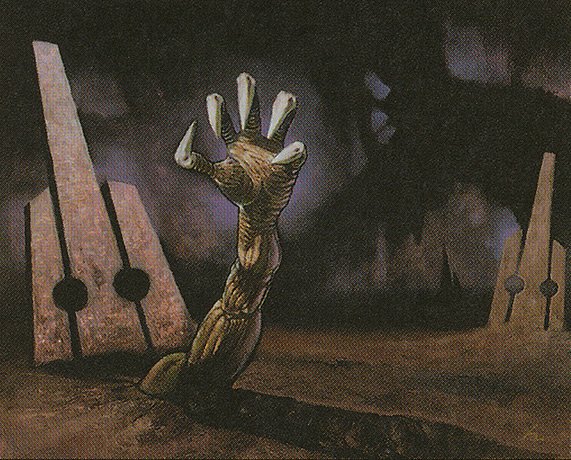
Design
Unearth Does Cube Synergy Perfectly
I think I’ve found my favorite card design of all time for Cube.
Study Unearth like a book, and you will learn everything there is to know about organic, emergent synergy design.
It Just Works
First, and most importantly, Unearth just plain works. It’s about as bread-and-butter as a spell can get, interacting with Magic’s most common card type, offering a

That’s not to say Unearth is some sort of instant-maindeck all-star like Dark Ritual or Thoughtseize, though. I wouldn’t play Unearth in a top-heavy Control deck, because
Neither is Unearth a “synergy glue card” like Chromatic Star or Golden Egg that happens to proc every other payoff in the cube. Unearth works with a lot of creatures, sure, but it only provides triggers to a narrow range of Young Pyromancers and Drake Havens. (Besides, the “glue cards” often come at the price of an impenetrable word salad, which requires some restraint.) Rather than taking the back seat as a selfless enabler, Unearth actually demands something of the drafter.
Thus, the deck that allows Unearth to shine the brightest is proactive midrange. A strategy that plays enough

Do we go for instant card and mana advantage? Light graveyard hate and mana sink? The highest-impact raw stats? Well, the answer probably depends on our hand and both sides of the battlefield. In a different turn, a different game, a different matchup, the answer will likely change drastically, and that means Unearth’s decision tree is always refreshing to explore.
A deck like this doesn’t happen accidentally. During the draft phase, we’ll have to select a toolbox of creatures, maybe prioritizing our 10th Unearth target over our 5th noncreature removal spell, maybe picking a Fleshbag Marauder over another Doom Blade. If we really want to go ham, then a few discard outlets or self-mill enablers will help us get good Unearth targets early. On the other hand, we can always just ignore these nuances and trust creature combat and Cycling to guarantee that Unearth won’t ever rot in hand.
See what I mean? Unearth just works, subtly contributing to fun creature-centric gameplay. But it also does so much more.
When Unearth is B-B-B-Busted
The ceiling of Unearth is a truly special thing. Turn 2, 5\6 flyer, “check.” Turn 4, swing for six hasty trample damage and two cards for the second time. My blood simmers just thinking about it.
You can build a cube where Skaab Ruinator is a viable card, where self-mill and discard fuel it as a reasonable Blue finisher (my love for such cubes is well-documented). Same goes for all kinds of ”
Or at least… it feels like we’re playing with fire. In actuality, Unearth’s Ruinator-style ceiling isn’t that much more powerful than its average case: creature stats, “enters” abilities, and combat keywords. Even these “combos” still engage with the fundamental fun of combat, and can be answered cleanly with any number of Doom Blades. That’s a good thing, because the cube designer gets all the benefits of true “combination decks” without any of the drawbacks.
True game-ending combos demand a lot of designer attention for Draft. Gaea's Blessing in duplicate is also a two-card combo, but it fundamentally changes the nature of matchups. To beat a self-looping control deck, drafters need some hyper-specialized hate pieces. Likewise, powerful versions of Reanimate combos may look like beefed-up Unearth, but they aim to cheat enormous amounts of mana. Path to Exile might handle an Archon of Cruelty, but the Reanimator player already got paid out. Unearth gives you that feeling of combo, without as many of the polarized non-games that result from the real McCoy.
Unearth as Micro-Archetype
Unearth combinations are sweet, so why not add more? You can have White Unearth, Unearth-on-a-stick in various colors, and Unearth guild signposts if you really want to go nuts. You can lean the archetype towards artifact creatures (pair with Goblin Engineer) or various creature types (my favorite being Ball Lightning plus Thunderkin Awakener).
The Unearth micro-archetype can be as big or small as you want. A modest cost of only a few slots, where every constituent piece still plays like a charm. My favorite part, though, is that an Unearth deck is emergent and discoverable even to players who’ve never seen your cube before, or never experienced traditional Reanimator before.
Emergence and discoverability are best defined by negation.1 Infect and all-in Dredge are non-emergent synergies, because these decks are totally uninterested in normal Magic cards for normal reasons.2 Meanwhile, KCI combo and Polymorph/Oath decks are completely undiscoverable. Zero drafters will see Scrapyard Trawler and think “hmmm I wonder what happens when I sac an artifact as a mana ability?” Zero. Even if you think you understand KCI, you do not.
Good ol’ Unearth is appealing and inviting to even new cubeheads. Seeing it in a pack for the first time, you might think, “huh, that’s a pretty sweet card, and a high floor.” Then: “ooh, it works especially well with some discard, sacrifice, and value ETBs.” And possibly, later: “ohmigod look at Skaab Ruinator i think i just broke the game.” These moments are always the highlight of a drafter’s night, but it’s equally important for the big-brain synergies to emerge out of the kinds of cards players enjoy and understand. Nothing does that better than Unearth.
More Cards Like Unearth
Here are some pale imitations of Unearth that I nonetheless still love. They look demanding at first, but they play well in the base case, and then they blossom into exciting, satisfying synergies. Rarely do the synergies break the glass ceiling and become true “combos,” but your players won’t care. They’ll be having too much fun drafting around their discoveries.
Go forth, ye cubeheads, and meditate on the emergent design perfection of Unearth! Thank you for reading about my new favorite card, and may all your Skaabs always be Ruinating.
- Or, failing that, by paragraphs of text. Astute readers will note that “It Just Works” is a long definition of emergence, and “B-B-Busted” describes the joys of discoverable combos.↩
- Not the same thing as “parasitism” or linearity. Dredge isn’t that parasitic of a mechanic — it actually plays as intended, as buyback-with-risk, in “normal Magic.” But all-in Dredge suddenly cares more about Phantasmagorian’s bizarro graveyard ability than it does the stats or mana cost (y’know, the normal parts). In a draft, that just means the Dredger stops reading signals and starts re-reading cards instead.↩