Star Magic Draft
Star Magic is a multiplayer format where dubious alignment between players creates an interesting political tension and strategic complexity. Exactly 5 players sit in a circle and play a free-for-all game. Unlike typical multiplayer games, a player wins when their 2 enemies — the two players seated across from them — are eliminated. Players seated next to each other can support each other to their advantage, but are still motivated to keep them in check so they or they risk their ‘neutral’ parties winning first.
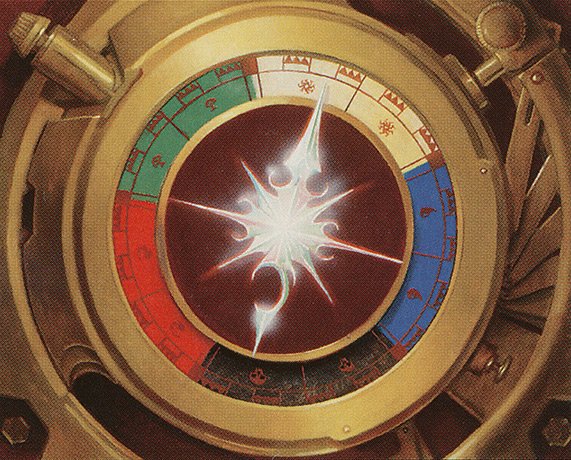
Historically, Star Magic has been a constructed format, sometimes with each player piloting a mono colored deck, mirroring the five points of magic printed on the back of every card, and the pattern of allied / enemy color pairs If you have a cube and five players, it’s a fun way to draft too!
How to Play
Five players do a standard Booster Draft of a cube. As with other booster drafts for smaller groups, more than three smaller packs is recommended. We suggest 4 packs of 11 cards, yielding a number of “wheeled” cards and final pool size similar to a normal 8 player draft. Each player builds their own deck as normal.
To randomize seating order, you can shuffle and deal a Plains, Island, Swamp, Mountain, and Forest and sit in





The Game
Without moving seats, play a single free-for-all game starting at a standard 20 life. As with other multiplayer formats, when a player loses they are eliminated. The game continues until one player defeats both of their enemies. Any other remaining neutral parties lose as well.
The star creates an interesting political dynamic. Adjacent players can collaborate and try to eliminate a shared enemy. But they always have to be wary their allies don’t take the entire game first. Players can attack any other player, although are usually only motivated to attack their enemies. When declaring attackers, each creature attacks a specific player and only that defending players’ creatures can block it.
The starting player does get to draw a card, but standard mulligan rules apply.
Cards that Care about Multiplayer
Many cards refer to “opponents” and some to team mates. For these cards, “opponents” only refers to the players enemies across the table.
Cards often scale in a reasonable an interesting way. Cards that would effect one opponent in a 1v1 game are often doubled in effect a novel but usually not game breaking recontextualization.
A cube could be designed specifically intended for Star Magic and might feature more cards that change in interesting ways, or exclude some that get confusing, awkward, or outshined. But any cube can be used.
Variations
Allies and Combat
While this is the rule set we recommend, many variations exist. Some groups prefer to not allow attacking neutral parties, although this can lead to some awkward end game states. Some groups also prefer treating all players as enemies for the purposes of cards that effect “each opponent.” This dramatically effects the texture of many cards.
Turn Order
A twist on turn order is to pass two players to the left — to the next enemy — after each player’s turn. This makes it so the turn order traces a real star pattern rather than a pentagon. Some feel not having your two enemies take turns in a row improves gameplay, but the effect is pretty minor and it’s easy to mix up the turn order.
Advantages of Star Magic
5 is one of the most difficult number of players to accommodate. So if you end up with an odd number at your Cube night, Star Magic can be a convenient way to make numbers work.
The multiplayer politics feel very different from a complete free-for-all. Players are not motivated to sit back and let their opponent’s drain each others resources while avoiding to draw any ire. Non-engagement is an easy way to let someone else win. So the gameplay moves forward in a way that’s substantially closer to 1v1 Magic. It’s a novel strategic experience worth trying.
Cubes designed for 1v1 Magic can play awkwardly in multiplayer. Many cards become essentially unplayable while others get over powered. Star Magic is a way to play multiplayer where Cube’s gameplay still feels largely intact.
Logistics
As with other multiplayer formats, the games can take some time. Upwards of an hour for a single game (or maybe more depending on the players!). Plan your Cube night accordingly. If a draft and three rounds is typical, you might instead do two separate drafts, followed by a single game each in the same amount of time.